

 Contact form
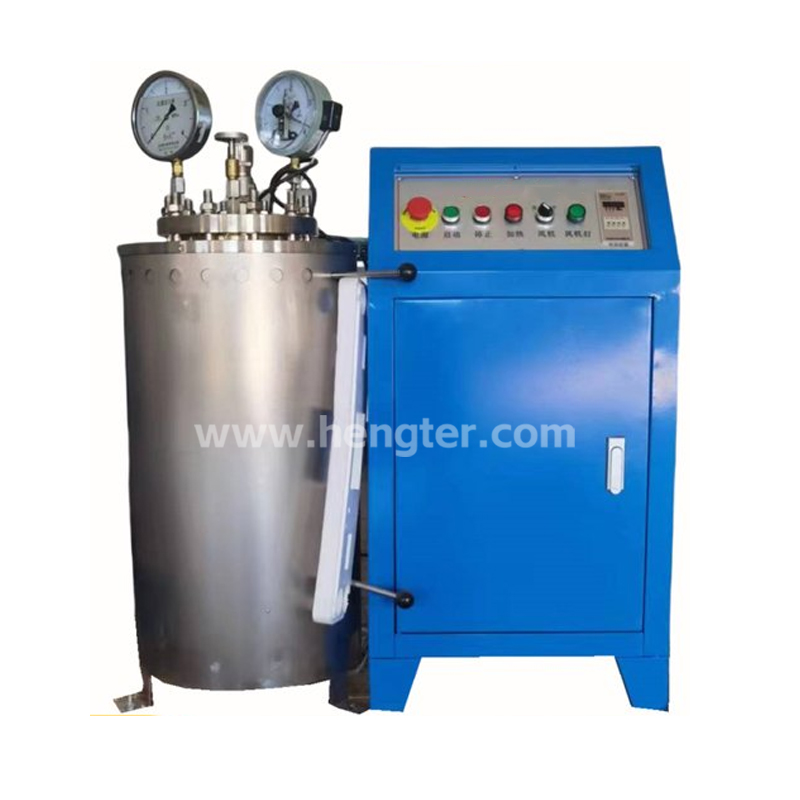
Overview: The cement autoclave tester complies with the national standard GB/750. It is a special instrument used by cement production units, building materials research institutes, colleges and universities, and construction engineering quality inspection departments to determine the adverse effects of gO (magnesium oxide) in cement on the soundness of cement.
The properties and testing of cement indicate that the content of MgO in cement clinker is mainly introduced by limestone raw materials. After the clinker is fired, most of the MgO exists in the form of periclase. Its structure is dense (commonly known as the dead-burned state) and is wrapped in clinker minerals, with an extremely slow reaction rate with water. It is generally believed that after 10 to 20 years or even longer, it continues to hydrate, generating Mg(OH)₂, which increases the solid phase volume by 2.48 times. The local volume expansion produces great destructive stress inside the already hardened cement stone. Boiling with the boiling method for 3 hours cannot make a large amount of MgO hydrate, so the boiling method cannot test the problem of cement soundness caused by periclase. High-temperature and high-pressure conditions can accelerate the hydration of periclase in the clinker. Therefore, the poor soundness caused by the content of MgO in the clinker must be tested by the autoclave method.
1、parameter
| 1. Volume of the kettle body: | 8.5L |
| 2. Inner diameter of the kettle body: | 157mm |
| 3. Maximum working pressure: | 2.0Mpa (manual adjustment) |
| 4. Pressure temperature: | (2.0Mpa±0.06Mpa; room temperature:215.7±2.6℃) |
| 5. Fluctuation range of automatic pressure control | >±0.06Mpa |
| 6. Setting of dwell time | 3h(Users can set it by themselves.) |
| 7. Safety temperature setting: | 220℃ |
| 8. rated voltage: | 220V |
| 9. Rated power: | 1800W |
2. Basic structure
Most of the main components of this instrument are made of high-quality stainless steel, which can withstand high temperatures and high-pressure saturated steam. The kettle lid is equipped with a stainless steel pressure gauge and an air release valve. The kettle body is installed inside the chassis and is additionally connected to a safety valve. Two electric heating sleeves are installed at the lower part of its outer side, which are used to heat the kettle body to generate water vapor; the bottom pipeline is connected to an electric contact pressure gauge, and the touch screen control system cooperates with the pressure gauge to control the pressure inside the kettle within the set range. An exhaust fan is installed at the lower part of the kettle body for exhaust and cooling after the test is completed. The upper part of the box is a control box, and there are start, stop, fan, heating, and constant temperature buttons on the panel respectively.